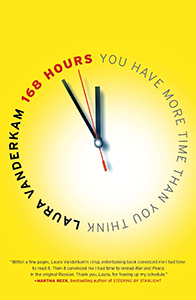
It was a weekend of much literary criticism. City Journal posted my review of Dan Pink’s Drive on Friday, and my round-up of three marriage related books, including Laurie Abraham’s The Husbands and Wives Club, and Stacy Morrison’s Falling Apart in One Piece, ran in the Wall Street Journal on Saturday under the headline When the Honeymoon is Over.
You can check out the promo video for 168 Hours here (run time 3 minutes). Kathryn Murphy, recipient of the time makeover discussed in the video, also makes a lengthy appearance in chapter 9 of the book. She was such a good sport for letting us film at her (gorgeous) home when she was 38 weeks pregnant!
This is why Google alerts are a good idea. Apparently, the Dallas Morning News picked up my City Journal essay on whether this recession will create a Lost Generation. My answer? Not so much–after all, unemployment hit double digits in 1982, yet today’s 50-year-olds don’t seem particularly more lost in their careers than the rest of us. Well, there’s more to the argument than that. But anyway, if anyone seeing this blog lives in the Dallas area I’d love to know if it was only online or in print as well.
Just an update on my whereabouts. I’m posting almost daily over at My168hours.com, which is the website for 168 Hours: You Have More Time Than You Think (pub date May 27). Please come check it out! I’m also starting to post at Twitter; you can follow me at @lvanderkam.
Health reform is supposed to make Americans healthier and make health care cost less. Most of us don’t believe Obamacare will do that. But here’s something that might: Instead of a health insurance mandate, how about an exercise mandate?
Oh, it’s not as insane as it sounds. Read my (tongue-in-cheek) column at AOL’s Sphere.
My column ran in USA Today this morning, also reprinted below:
What Else Could That Ring Buy?
By Laura Vanderkam
Valentine’s Day is here again, and with it, a perennial bloom of marriage proposals from the romantically inclined among us. In our consumer culture, that means that over the next week, thousands of prospective brides will don new diamond rings, with friends noting the size as evidence of the groom’s devotion. Even with the not-so-sparkly economy, the average couple spends (according to the 2008 Wedding Report) $3,215 on an engagement ring and $2,036 on wedding bands.
It’s a lot of money, a testament to the power of love and De Beers’ marketing. But after interviewing lots of weary young parents over the years, I’ve decided that there’s an irony to this purchase. That five grand, and indeed, the whole $20,000-plus average wedding tab, is spent when a marriage least needs it — when love is gleaming as bright as a diamond. It’s later that “life gets in the way of marriage,” as Dallas-area marriage therapist Corey Allan puts it. Then, the money could be invested more strategically in making a couple live happily ever after. Unfortunately, few couples basking in the glow of early romance consider the practical side of what all that wedding cash could buy them.
A fairy tale ending
Nuptials have long filled the thoughts of little girls who grow up fantasizing about bouquets, veils and the swish of a white dress. Allan, who blogs at simplemarriage.net, notes that “I have a 4-year-old and she plays wedding already.”
These decades of dreams — plus a multibillion dollar industry — tend to point couples toward lavish spending on one perfect day. When journalist Hannah Seligson was researching her new book, A Little Bit Married, about why couples tie the knot, she heard the story so many times of fathers offering cash for either a blow-out wedding or a house down payment and the bride choosing the wedding, she stopped being surprised. “It all becomes about picking the right flowers, should you have toile on the seats, all these minor decisions,” Seligson says.
We have our cultural narratives, and “once you find the person, you’re always riding off into the sunset,” says Alisa Bowman, who runs a website called Project Happily Ever After. In fairy tales, the wedding comes right before “The End.”
This is, of course, ridiculous. In real life, you still have to get out of bed the next morning. Bowman and her husband began their marriage as infatuated as all couples. Then they faced a colicky baby, illness and money troubles, and suddenly, “I was fantasizing about divorce several times a day,” she reports. Their experience is not unusual.
Even the most loving marriage can be strained by small children and the fights over housework, finances and time that ensue. One recent Redbook poll found that 63% of its mostly mom readers went out on “date night” once a month or less. Amid the diaper and grocery bills, many couples feel as if there’s just no money for romantic extras.
Except that once there was.
The $5,251 the average couple spends on rings could be viewed as 105 nights of paying $50 to a babysitter so you can have an uninterrupted conversation, or neck in your car like teenagers.
The average $11,000-plus wedding reception bill could cover a cleaning service for the five sticky years many two-kid couples spend in that baby stage, when children spill milk just to see what will happen. The $1,240 brides spend, on average, to buy (and preserve) their dress, veil and shoes could cover 48 weeks of a laundry service. That’s four years of outsourcing this chore once a month when things get rough. The average $1,276 flower bill could be doled out, instead, as 127 $10 thinking-of-you bouquets — a once-a-month gesture of love for a solid decade.
Wedding vs. marriage
Indeed, the couple could elope, purchase a cubic zirconium ring for show, and invest the whole $20,000-plus wedding price tag in starting a business together. That might ultimately pay off in both financial security and the flexibility self-employed people enjoy to better balance work and life, long after your guests would have eaten the Jordan almonds you might have given as favors instead.
The point of all this is not that spending big bucks on a wedding is wrong. My own was not exactly cheap. The point for the young and betrothed — and for anyone, really — is that how people spend money and time are choices. Rather than buy a big house and work overtime to afford its upkeep, you can live simply and work less. It is a choice to watch television rather than exercise; it is a choice to check your e-mail instead of reading with your kids. Time and money spent on one thing is time and money not spent on something else, and these choices have consequences. According to an oft-repeated industry statistic, it takes 250 hours to plan a wedding. Imagine if the average couple spent anything close to that hashing out how they would communicate and solve problems to keep their love blooming years hence.
This is how Bowman ended up saving her marriage. While planning a wedding is tough, “where the true hard work comes is afterwards,” she says. Babysitters and laundry services might not seem as romantic as toasting flutes and wedding cake toppers, let alone a big rock in a Tiffany box. But in the long run, says Bowman, “the ring doesn’t keep you together.” A little investment in a marriage just might.
Laura Vanderkam, author of the forthcoming book 168 Hours: You Have More Time Than You Think, is a member of USA TODAY’s board of contributors.
My column on the Good Housekeeping Research Institute, and Consumer Reports, ran in today’s Wall Street Journal as “They Don’t Just Trust–They Verify.”
Also, my column on the Network for Teaching Entrepreneurship’s business plan contest ran in AOL’s Sphere as “A Better Contest to Watch on Super Bowl Sunday.”
Roughly a year after the $787 billion stimulus bill became law, the Obama administration is claiming that it created or saved 1.7-2 million jobs. While that’s at least better than the 640,000 it was claiming in October, for 2 million jobs, that still comes out to $393,500 per job. Spread over 2 years, that’s still $196,750 per job per year–nice work if you can get it! That’s quite a bit higher than the average wage plus benefits afforded to federal government workers ($119,982 per year) and much higher than that earned by private sector workers ($59,908).
It suggests that if the goal were simply to create or save jobs, the stimulus bill is doing this in a very inefficient fashion. If the government had simply paid people $100,000 in salary and benefits (and administration costs) for two years, it could have created 3,935,000 of these “jobs.” I’m not sure what we’d get out of people having these “jobs,” but it’s not entirely clear what we’ve gotten out of the stimulus yet, either.
I keep a blog on gifted education matters called Gifted Exchange. Today’s post talks about the recent Atlantic article on “What Makes a Great Teacher?” You can read my take here.
My column on the rise of the craft economy, “Handmade is the new black,” ran in USA Today this morning. We have grown accustomed to having high-quality, reasonably priced goods available whenever we want them. So now, increasingly, we want to make our world special. Buying truly one-of-a-kind handmade items is a way to do that. It is, on some ways, simply a redirected consumerism, but since that impulse gives American artists a real chance to make a living, I think that trend is worth cheering. So please check the column out!